
AI models
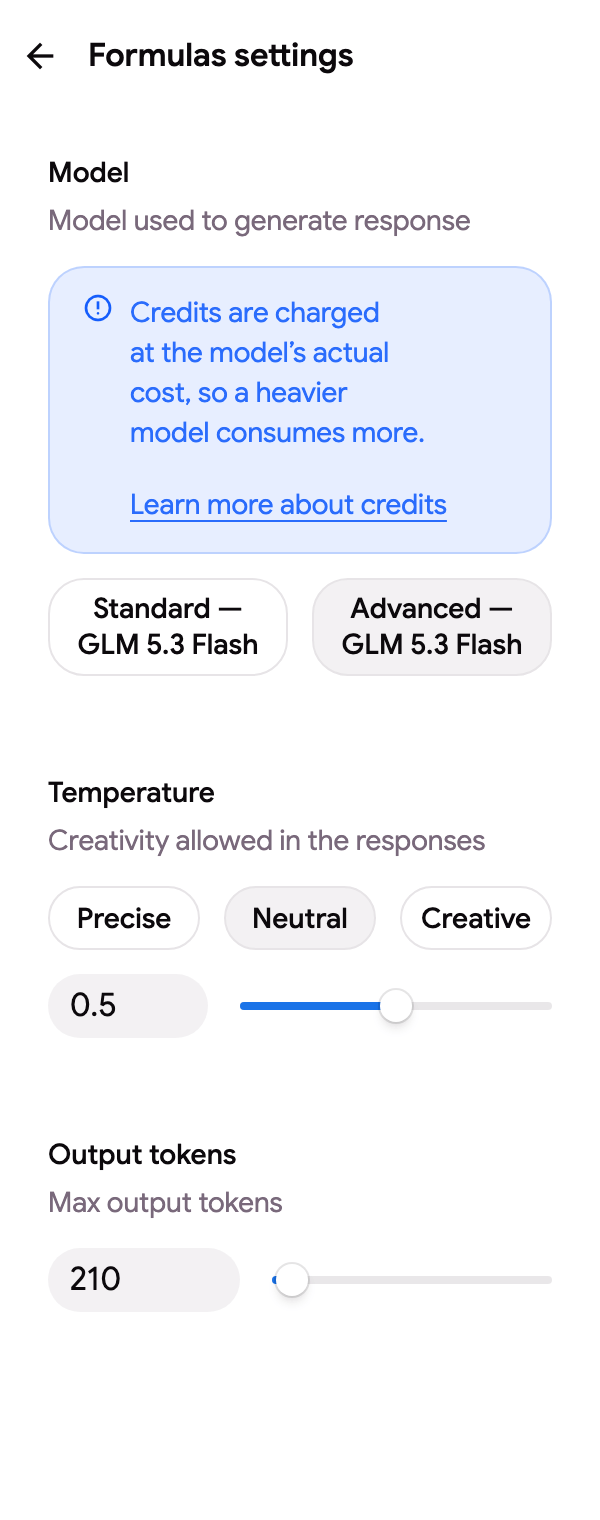
GPT Workspace picks the model for each job and charges credits at the model’s actual cost, see What is a credit?. You choose a tier in Sheets formulas and an image model in =GPT_IMAGE; the chat agents select their models themselves.
Sheets formulas: Standard and Advanced
Section titled “Sheets formulas: Standard and Advanced”| Tier | Model | Plans |
|---|---|---|
| Standard | GLM 5.3 Flash | All plans |
| Advanced | GLM 5.3 Flash, where newer and heavier models are added first | Standard and Pro |
Both tiers are kept up to date with current models. The tier is set per formula with the model parameter, =GPT("…", A1, , "advanced"), or for all formulas in Formula settings.
=GPT_CLASSIFY uses a dedicated decision model (TypeSafe Jev) that is about ten times cheaper than a text formula.
Chat and agents
Section titled “Chat and agents”The chat runs a main agent and one specialist per Google app. They use the current frontier models (GPT, Claude, Gemini and GLM families) chosen per task: a fast model for routing and short answers, a stronger one for writing and planning, a multimodal one for files and images. Advanced models in chat are available on every paid plan.
Image models
Section titled “Image models”=GPT_IMAGE and the chat’s image generation let you pick the model:
model value |
Model | Relative cost | Plans |
|---|---|---|---|
gemini (default) |
Gemini 3.1 Flash Lite Image (nano banana) | lowest | All plans |
gpt |
GPT Image 1 mini | low | All plans |
openai/gpt-image-2 |
GPT Image 2 | high | Paid plans |
google/gemini-3-pro-image |
Gemini 3 Pro Image | highest | Paid plans |
Legacy names (dall-e, dall-e-3, gpt-image-1, gpt-5-image) keep working and map to the closest current model.
Web search model
Section titled “Web search model”=GPT_WEB and the chat’s web search use Perplexity Sonar Pro Search, which has live web access. =GPT_WEB is available on paid plans; because the provider bills per search whatever the length of the answer, each call carries a minimum charge.
Files in formulas
Section titled “Files in formulas”=GPT_FILE reads PDFs, images, audio and video with a multimodal Gemini model, and indexes other documents for search, see GPT_FILE.